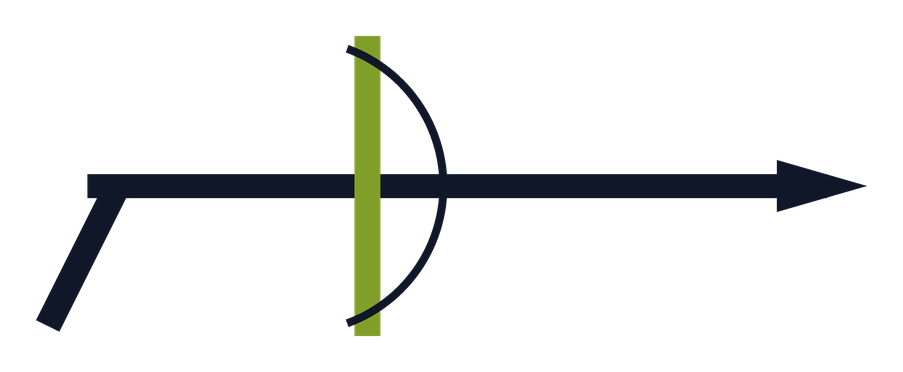
"How does a crossbow work" is a real, dedicated question, 320 monthly searches, and it deserves a real answer, not a sales pitch. This article explains the actual mechanics: what happens when you cock a crossbow, what a cam system does differently from a traditional recurve limb, and why two crossbows can look similar but perform very differently.
The basic mechanism
A crossbow is a bow mounted horizontally on a stock, with a mechanism that holds the drawn string under tension until a trigger releases it. Cocking the bow, pulling the string back until it catches on the trigger mechanism's latch, stores energy in the limbs. Pulling the trigger releases the string, which pushes the arrow (called a bolt in crossbow terminology) down a rail at high speed. That's the same basic principle a vertical bow uses, just reoriented so the string travels a shorter distance and the whole assembly can be held steady and aimed like a rifle, rather than drawn and held by the shooter's own arm strength at the moment of the shot.
Recurve vs. compound: two different limb designs
The crossbows in this niche split into two broad limb designs. A recurve crossbow uses limbs that curve away from the shooter at the tips, storing energy directly in the flex of the limb material, mechanically the simpler of the two designs, and the type used in CenterPoint's entry-level Hornet model. A compound crossbow adds a system of cams (eccentric pulleys) at the ends of the limbs, connected by cables, which changes how the draw force is applied through the cocking stroke. Most of the higher-performance models sold by both merchants we track, CenterPoint's Amped G2D, Sinister 430D, Hellion 400, and AT400, and Ravin's entire lineup, are compound designs.
Why draw weight isn't the whole story
A cam system is exactly what explains one of the more surprising real numbers in this niche: Ravin's compound flagships, the R470 XERO XK7 and R500, both have a published draw weight of just 17 lbs, dramatically lower than CenterPoint's 185-200 lb compound models, yet Ravin's models are rated at higher speeds (470-500 fps vs. CenterPoint's 400 fps). That's not a contradiction, it's the cam system changing how force is applied and stored through the draw cycle, which decouples "how hard is this to cock" from "how much energy does the bolt leave with." We go deeper on this specific comparison, including what it means for choosing a crossbow, in our draw weight explainer.
A crossbow stores energy in its limbs when cocked and releases it through a trigger mechanism, the same basic principle as a vertical bow reoriented onto a stock. Compound designs add a cam system that can dramatically lower the felt draw weight (as low as 17 lbs on Ravin's confirmed models) while still producing higher rated speeds than a traditional design's 185-200 lb draw weight.
What actually gets measured on a spec sheet
A few terms show up on almost every crossbow's spec sheet, and knowing what they mean makes comparing models much easier:
- Speed (fps), feet per second the bolt travels, measured under the manufacturer's own stated test conditions (typically a specific bolt weight, which isn't always disclosed).
- Draw weight (lbs), the force required to cock the bow, or on a cam-assisted design, the felt effort at the cocking mechanism rather than a raw limb-tension number.
- Kinetic energy (ft-lbs), the energy the bolt carries, which combines speed and bolt weight, and is a more complete performance indicator than speed alone.
- Axle-to-axle length, the width of the crossbow measured limb tip to limb tip, both cocked and uncocked on some models, which affects maneuverability in a blind or stand.
- Power stroke, the distance the string travels from its resting position to the latch, a major factor in how much energy a given draw weight can generate, though it's frequently left unpublished on manufacturer pages (as it is on every model in both catalogues we track).
Cocking mechanisms
Cocking a crossbow by hand gets harder as draw weight increases, which is why most higher-draw-weight models ship with or support a cocking aid. CenterPoint's Sinister 430D uses a "fully integrated silent crank system," and its Amped G2D and AT400 both include a detachable or auto-retracting silent cocking mechanism rather than requiring a bare-handed draw. These mechanical aids trade a slightly longer cocking process for a dramatically lower physical effort, which matters more the higher a model's draw weight is.
How we verify this guide
The specific speed, draw weight, and energy figures cited above come directly from CenterPoint's and Ravin's own product pages for the models named, not from a generic explanation of "how crossbows work in general." Where a spec (like power stroke, on every model in both catalogues) isn't published by the manufacturer, we say so rather than estimating.
FAQ
Is a compound crossbow always more powerful than a recurve one?
Generally yes, in terms of speed and energy for a given size and cost, which is why the higher-performance models from both merchants we track are compound designs. A recurve design's simplicity and typically lower draw weight make it a reasonable choice for target shooting or an entry-level setup rather than serious big-game hunting.
Why does a crossbow need a safety mechanism if the trigger controls the shot?
A cocked crossbow holds a significant amount of stored energy in its limbs at all times until fired, so a mechanical safety (separate from simply not touching the trigger) is a real, standard second layer of protection against an accidental release. See our safety rules guide for how that fits into safe handling generally.
What does "dry-firing" mean, and why is it dangerous?
Dry-firing means pulling the trigger on a cocked crossbow with no arrow loaded on the rail. Without an arrow to absorb the released energy, that energy transfers into the crossbow's own limbs and stock instead, which "can cause serious equipment damage and shooter injury" according to Alaska's official bowhunter-education crossbow safety course. It's one of the most consistently repeated rules across every crossbow safety resource we found researching this site.
Sources
- [S001] CenterPoint Archery : Crossbows category page and individual product pages (Amped G2D, Sinister 430D, Hellion 400, AT400, Hornet), (accessed 2026-09-09)
- [S002] Ravin Crossbows : Crossbows listing page and R470 XERO XK7 / R500 product pages, (accessed 2026-09-09)
- [S003] bowhunter-ed.com (Alaska Department of Fish and Game official course) : Crossbow Safety Rules, (accessed 2026-09-09)